->Nederlands
contents
1. abstract
2. tracklist, listening links
3. press
4. liner notes
5. biographies
6. other details
abstract
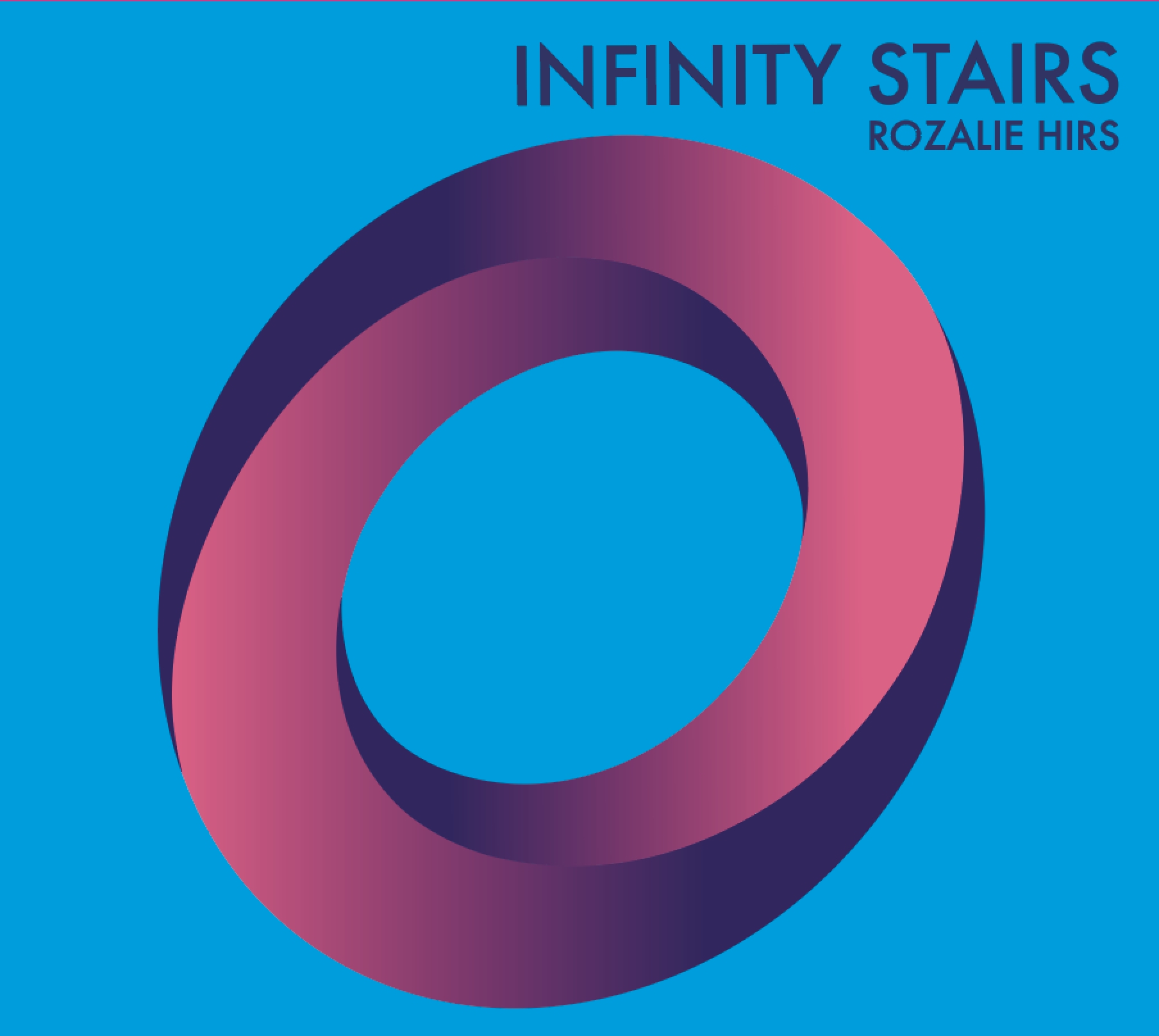
On 8 August 2025, the portrait album Infinity Stairs (2025) by Rozalie Hirs was released. It includes new recordings of her chamber and solo compositions. Listen to the full album on Spotify or Apple Music.
tracklist, listening links
1 article 10 [prismes] (2021) 12’23”
Marie Ythier (cello)
2 article 5 [delphin, gekrümmte zeit] (2008; 2022 rev.) 10’57”
Keren Motseri (soprano)
3 article 6 [waves] (2013) 9’52”
Wiek Hijmans (electric guitar)
4 article 7 [ways to climb a mountain] (2012) 12’55”
Fie Schouten (bass clarinet)
5 article 8 [infinity] (2014) 9’24”
Marieke Franssen (flute)
6 infinity stairs (2014) 11’30”
Marieke Franssen (flute), Fie Schouten (bass clarinet), Wiek Hijmans (electric guitar)
Listen to the full album on Spotify or Apple Music.
press
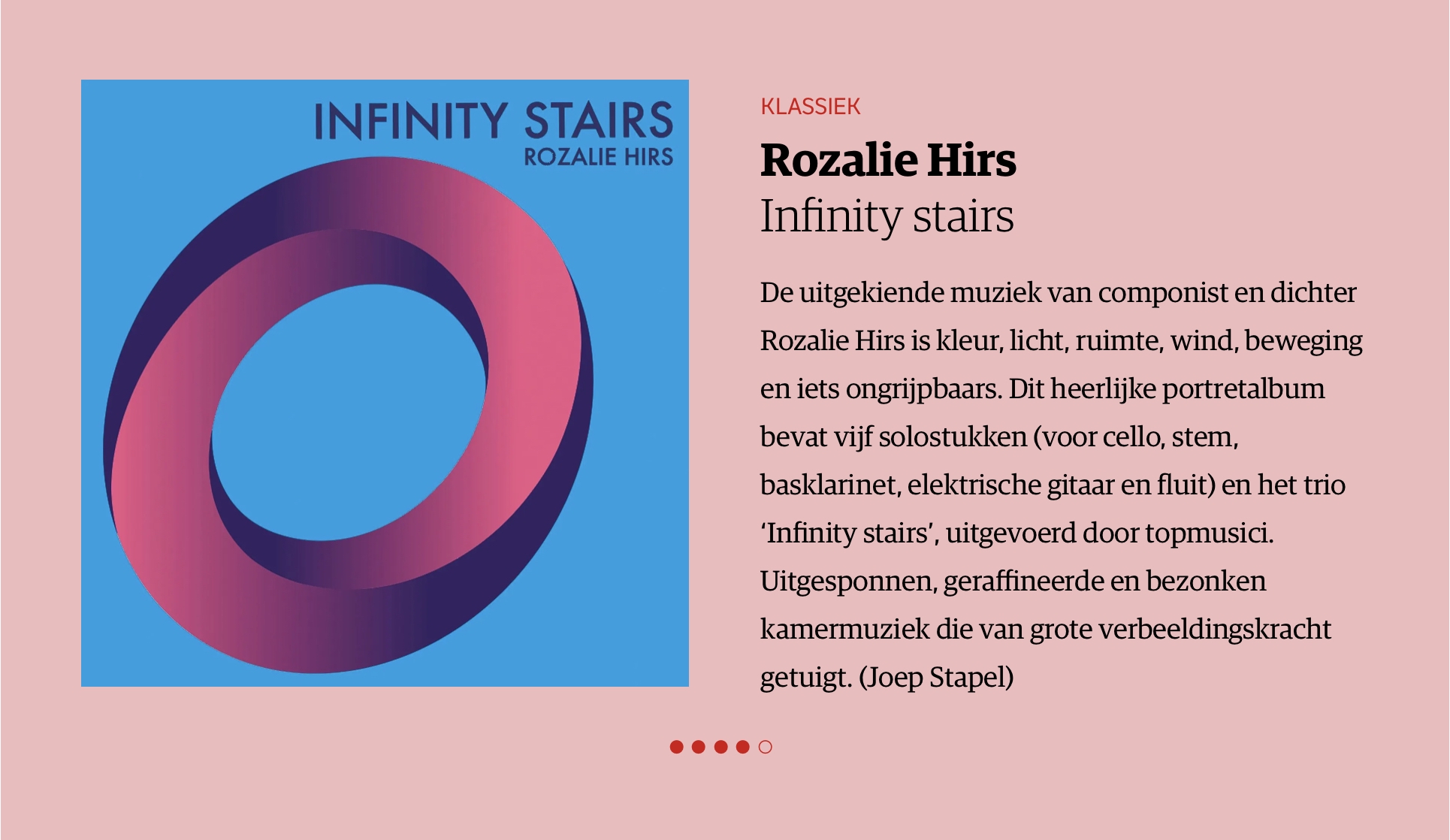
Joep Stapel: Infinity Stairs
“The finely crafted music of composer and poet Rozalie Hirs is color, light, space, wind, movement, and something elusive. This wonderful portrait album features five solo pieces (for cello, voice, bass clarinet, electric guitar, and flute) as well as the trio Infinity Stairs, performed by outstanding musicians. Expansive, sophisticated, and contemplative chamber music that reveals great imagination.”
CLASSICAL ★★★★☆
Read Joep Stapel’s full review on the NRC, of August 29, 2025 (online).
Dennis Bajram: The music of Rozalie Hirs is at once mathematical, colorful, and spiritual
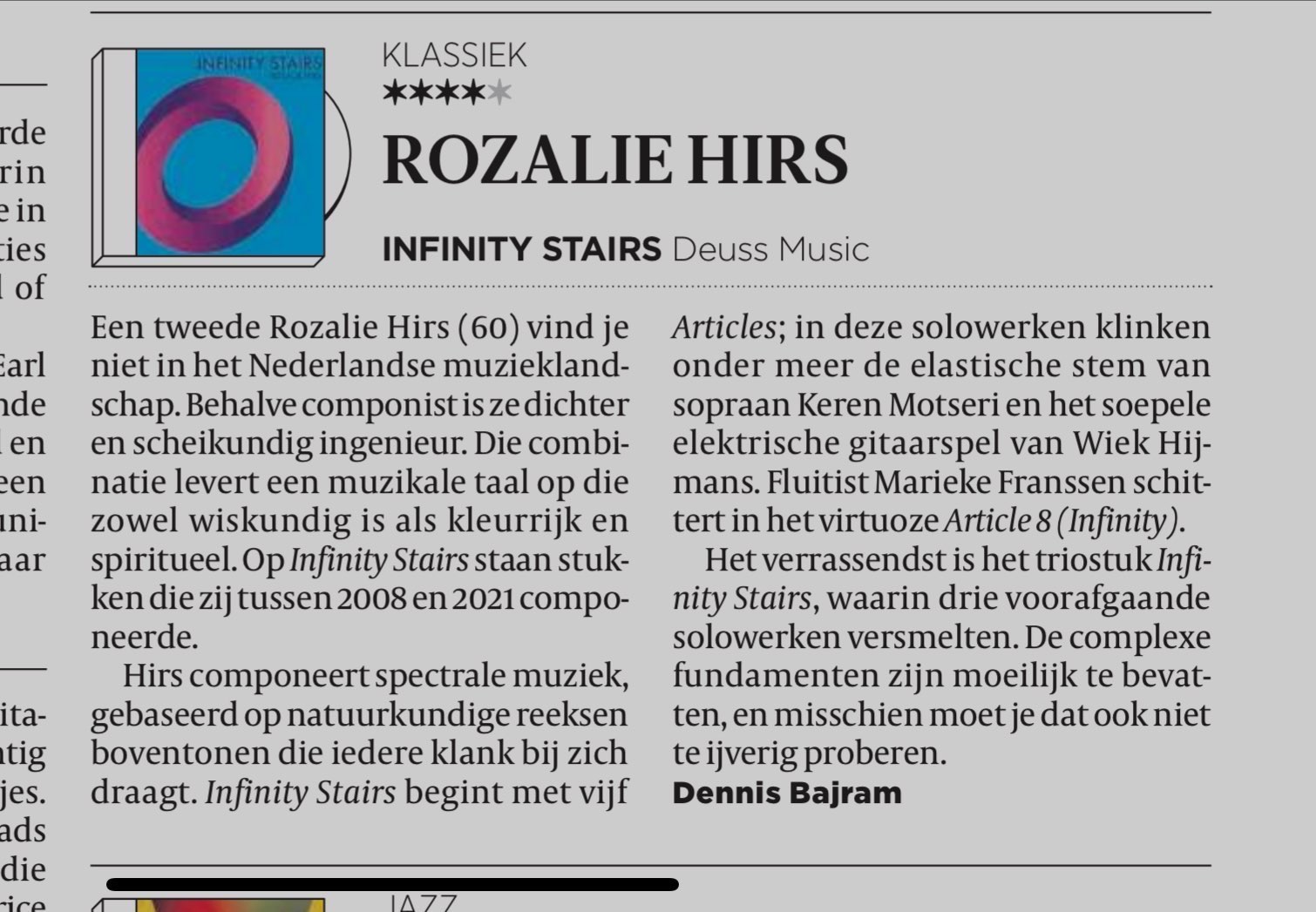
There is no one quite like Rozalie Hirs (60) in the Dutch musical landscape. A composer, poet, and chemical engineer, she brings these disciplines together in a musical language that is simultaneously mathematical, colorful, and spiritual. Infinity Stairs gathers works she composed between 2008 and 2021.
Hirs writes spectral music, rooted in the natural overtone series carried within every sound. The album opens with five Articles: solo works that showcase, among others, the elastic voice of soprano Keren Motseri and the supple electric guitar playing of Wiek Hijmans. Flautist Marieke Franssen dazzles in the virtuosic Article 8 (Infinity).
The most striking piece is the trio Infinity Stairs, where three earlier solo works merge into one. Its intricate foundations can be difficult to fully grasp — though perhaps it’s best not to try too hard. What matters is this: as Hirs reflects and explores, she creates sonic worlds that feel at times familiar, at times uncannily strange.
ALBUM
Rozalie Hirs
Infinity Stairs
CLASSICAL ★★★★☆
(Dennis Bajram, Volkskrant, 28 August 2025)
Aart van der Wal: Infinity Stairs

In May 2018, Siebe Riedstra discussed a number of works by Rozalie Hirs (b. 1965, Gouda): Platonic ID for ensemble, article 0 for percussion, articles 1–3 for piano, article 4 for violin, and Book of Mirrors for ensemble.
There he also touched on the ideal of this versatile artist, who moves with ease between music, poetry (she is also an acclaimed poet), science, and technology:
“Shall I tell you what my ideal is? That I learn to write a kind of music that engages in dialogue with the physical and psychological processes of the brain. A music of the senses, communicating with the listener. Ideally, I try to give the listener an experience they have never had before.”

That is what drives her artistically and constitutes her artistic credo—then and now. Nor did it come out of the blue, as her “baptismal record” shows. To begin with, there was from early on her great interest in language (poetry) and music, seen as well from a strongly scientific and technological perspective—interests that also nourished her singing, writing, and composing. From her teenage years she studied piano and voice, and later chemical engineering at the University of Twente (Master’s, 1990). From 1991 she delved into composition with Diderik Wagenaar at the Royal Conservatoire, and later with Louis Andriessen. From 1999 to 2002 she pursued further study with Tristan Murail at Columbia University in New York, this time focused on spectral music. In 2007 she obtained the Doctor of Musical Arts degree (dissertation and composition on the aforementioned Platonic ID), devoted to contemporary and spectral compositional techniques and the software used in them, including OpenMusic.
What Rozalie Hirs creates in her vocal, instrumental, and electroacoustic music is not only exceptionally accomplished but also unique. By applying spectral and psychoacoustic phenomena with the aid of computer software, frequency analysis, sum and difference tones, microtonality, and electronic (and thereby acoustic) resonance, she brings the listener into contact with a completely new world of sound—a world in which, alongside an inspiring wealth of ideas, technology plays a dominant role. But there is more: the avant-garde interweaving of “ordinary” musical instruments with electronics.
The ingenious and distinctive nature of Hirs’s concepts has brought her many prestigious commissions, including from Amsterdam Sinfonietta, ASKO|Schönberg, Klangforum Wien, Ensemble Musikfabrik, and the Radio Philharmonic Orchestra. Her work is performed at the most prestigious music festivals at home and abroad, including the Holland Festival and the Donaueschingen Festival dedicated to the newest music.
What does her music ask of the listener? That is not easy to capture in words, though it certainly calls for a generous measure of openness. There are no classical, traditional, or conventional patterns supporting her musical creations. In the most literal sense it is a new sound—and thus also a new way of listening. The reviewer (and surely not he alone) is thereby faced with the impossible task of describing this music adequately. Listening, and undergoing the spectrum of sound without preconception, is the only answer. What helps in this respect is that the development of sound in Hirs’s pieces often proceeds slowly and fluidly, almost dreamlike or even meditative. It is as if the spectralists were laying an aural magnifying glass upon sound and letting us listen into the interior of a tone as it slowly unspools.
Because Hirs’s music springs from her extremely refined aural and unique imagination—thinking in frequencies, microtones, and spectral structures; sound as matter—she enters a terrain that is unfamiliar to most listeners. The auditory experience is not analytical, but that of a field of sound: an atmosphere of sound that unfolds. There is no clear melody or rhythm, but there is an intriguing interaction between electronic and acoustic resonances. Hirs cannot and will not expect the public to understand everything; she can only hope that it opens itself to her music. That amounts—as I have already noted—to an entirely different way of listening. An important aid here is the commentary in the CD booklet and on her website.
The use not only of software and electronics—which lend themselves relatively easily to all manner of processes and moreover are not bound by human limitations—also requires collaboration with carefully selected instrumentalists. Unlike in traditional musical forms, they must be able to handle microtonal structures and to act in coordination with electronics. That asks much, both of the performing musicians and of the instruments. But it also asks much of the composer, who thereby embarks upon a far more complicated trajectory than merely conceiving and working with electronic phenomena.
The five musicians on this album—each performing at the highest level—create, each in solo works (in the final piece Infinity Stairs there are all three together), a fascinating sonic image of absolute rhythmic precision and a perfect sense of timing, with extremely varied playing techniques, alongside the ability to hear and to intone perfectly the most complex overtone structures. One should bear in mind that in microtonality the pitch intervals are smaller than a semitone (for example, one-fourth or one-eighth of a tone).

In the recent article 10 [prismes] (2021) the exact frequencies are notated, to which the musician must literally tune (in Hz). The earlier article 5 [delphin, gekrümmte zeit] (2008) is notated in semitones; the other four pieces on the album in quarter-tones. In these pieces, the absolute frequencies were first calculated within a continuous frequency space, then rounded to semitone or quarter-tone steps. Here one recognises the idea of playing along with the (acoustic) sound space. It seems that Hirs and her performers together explore the limits of their instruments and are prepared to experiment with sound and space.
In Hirs’s discourse it is not a matter of expression in the traditional sense (pathos, contrast). Rather, it is a matter of strictly measured intensity, in which the long spans of tension admit no theatrical expressiveness — nor is any needed. The focus lies on absolute control of the most delicately nuanced timbres. Even the slightest change in pitch or resonance can produce striking effects in the relations between sounds. Alertness and inner stillness here are no opposites, but merge seamlessly within this sonic image.
Infinity Stairs — endless stairs: frequencies overlapping to form an acoustic “staircase” of resonances. For the listener this evokes a meditative, undulating sound space in which time and pitch flow into one another. In this connection one might recall Wagner’s Parsifal (Act I, Scene 3), where Gurnemanz says: “Du siehst, mein Sohn, zum Raum wird hier die Zeit.” (“You see, my son, here time becomes space.”) The movement of Parsifal and Gurnemanz there arises solely through music, light, and mise-en-scène.
From the CD booklet comes this passage:
“Notably, articles 6–8 can be performed with optional electronic sounds and were designed to be played simultaneously as the trio infinity stairs (2014), with or without electronics; these three solo compositions can also be reimagined as various duos, though these have not yet received separate titles. Composed for adventurous contemporary musicians, they represent a critical phase of research and discovery for Hirs.”
Also interesting are the remarks concerning articles 6, 7, and 8:
“Article 6 [waves] (2013) and article 8 [infinity] (2014) were composed consecutively, with each drawing material from its predecessor. waves reinterprets the overtones from ways to climb a mountain as fundamentals, while infinity derives partials by treating waves as a sequence of fundamentals. The resulting frequencies were approximated to the nearest quarter tone, and durations were first calculated in continuous time before being notated in practical rhythms. This interconnected approach fosters both inner resonance and unity among the works, despite their virtuosic demands.”
Naturally, Hirs is not the first nor the only composer to engage with the mathematically grounded concepts of spectralism and overtone series. A glance at the lineage reveals both familiar and lesser-known names: Gérard Grisey (1946–1998), Hirs’s teacher Tristan Murail (*1947), Hugues Dufourt (*1943), Michaël Lévinas (*1949), Roger Tessier (*1939), Kaija Saariaho (1952–2023), Magnus Lindberg (*1958), Georg Friedrich Haas (*1953), Claude Vivier (1948–1983), and Jonathan Harvey (1939–2012) — and even this list is far from complete.
For Hirs, frequency calculations are never an endpoint but — so we read in the booklet — merely one of the “tools” for creating rich, resonant harmonies and sonic coherence. Ultimately it is the composer’s intuitive ear that decides which of the calculated harmonies and rhythms find their place in the final score.
Perhaps the foregoing has created the impression that Hirs’s composing by definition implies the use of electronics. That is not the case, as the present album also shows. The articles are technically very demanding. Articles 5–8 and the trio for flute, bass clarinet, electric guitar Infinity Stairs are spectrally rooted and employ a method based on specific frequencies. This requires utmost precision in pitch and rhythm.
Article 10 [prismes] for solo cello is another telling example. The work, written in 2021 on commission from Radio France, revolves around the spectral exploration of tonalities. It breaks tones and chords into harmonic partials or overtones, creating luminous harmonic textures reminiscent of light refracted through a prism — hence the subtitle. The shimmering melodies flow together in waves and thus evoke a constantly changing sonic landscape. By applying layered frequencies, Hirs enables the listener to perceive subtle shifts in texture and color — comparable to the play of light within a multifaceted prism. The piece unfolds in waves of sound, with gradual transformations and finely woven variations that convey a sense of fluidity and organic growth.
How, in fact, does spectralism stand in our country—originating in France in the 1970s, with Grisey, Murail, and Dufourt as central figures?
In the Netherlands there has not, as yet, been any formation of a school: spectralism found only individual application and stood at the edge of a broad spectrum of pluralistic currents (minimalism, conceptual music, post-serialism, new complexity). Only from the 1990s onward did a renewed awareness of sound structure, acoustics, and perception emerge — partly through the influence of IRCAM, spectral-analysis techniques, and collaboration between composers and scientists. Within that context several Dutch composers, among them Jan van de Putte (b. 1959 — seeking an “inner sound space,” the perception of time as lived experience, related to Hirs yet more spiritual) and Robin de Raaff (b. 1968 — for whom not the system but the tension and expressivity of music are decisive), developed their own poetically inspired variants of spectralism.
Spectralism has therefore not led to a true “school” in our country. It should rather be seen as a field of personal interpretations. Whereas the French pioneers — and now Rozalie Hirs — proceeded from scientific analysis and computation, translating the calculated frequencies into the score, the Dutch composers mentioned link these to poetic, spiritual, or dramaturgical dimensions. In the works of Rozalie Hirs, Jan van de Putte, and Robin de Raaff, spectralism thus becomes a means of exploring musically the experience of time, colour, and consciousness, and of sharing that experience with the listener — as a perception of the very nature of things.
(Read the full review (Dutch) on Opus Klassiek, 15 October 2025)
liner notes
Infinity stairs
Infinity Stairs (2025) is the long-anticipated portrait album of Rozalie Hirs’ chamber music, showcasing the titular trio and the latest additions to her articles series. The latter include compositions for solo soprano, electric guitar, bass clarinet, flute, and cello: article 5 [delphin, gekrümmte zeit] (music, text; 2008; German version, 2022), article 6 [waves] (2013), article 7 [ways to climb a mountain] (2012), article 8 [infinity] (2014), and article 10 [prismes] (2021).
Hirs’ music is deeply inspired by mathematical and physical concepts, particularly those tied to spectralism and the overtone series. For her, frequency calculations are not ends in themselves but tools for crafting rich, resonant harmonies and achieving sonic coherence. Her works resonate with an intrinsic harmony that encourages reflection on the nature of sound and perception. Ultimately, the composer’s intuitive ear determines which calculated harmonies and rhythms are included in the final score.
article 10 [prismes] (2021), commissioned by Radio France, is a spectral exploration of tonalities. It refracts tones and chords into harmonic partials, or overtones, creating vibrant harmonic textures akin to light passing through a prism. The shimmering melodies bend and ripple, evoking an ever-changing landscape of sound. By layering frequencies, Hirs enables listeners to perceive subtle shifts in texture and color, much like the interaction of light with a multifaceted prism. The piece unfolds in waves of sound, with gradual transformations and nuanced variations that create an impression of fluidity and organic growth.
A defining feature of article 10 [prismes] is its use of sum and difference tones, a psychoacoustic phenomenon. These additional tones are perceived when two simultaneous pitches interact, producing phantom tones at the sum and difference of their frequencies. Hirs incorporates this effect, allowing listeners to experience these spectral illusions directly. These phantom tones seem to materialize out of thin air, blurring the line between physical sound and auditory perception. In prismes, they contribute to the work’s multi-layered textures, crafting a shimmering, multidimensional soundscape that deepens the meditative quality of the piece. The harmonic spectra also guide the composition’s overall structure, inviting listeners into a sound world where time feels elastic, and the richness of harmonic spectra unfolds slowly.
Articles 5–8 and the trio infinity stairs are among Hirs’ most technically demanding compositions, rooted in spectralism and frequency-based methods. These works require exceptional precision in pitch and rhythm, presenting significant challenges for performers.
The earlier work article 5 [dolphin, curved time] (2008) for solo soprano is based on Hirs’ poem ‘tuimelaar’ (‘bottlenose dolphin’) from her poetry collection Geluksbrenger (Lucky Charm, Querido, Amsterdam, 2008). In 2022, she created the German version of the composition, article 5 [delphin, gekrümmte zeit], based on the German translation of the poem, featured in her multilingual poetry collection gestammelte werke (work in stuttering, kookbooks, Berlin, 2017). Both compositions employ intricate calculations, processing source materials through pitch and time distortions. These materials originate from Hirs’ orchestral work roseherte (2008), which explores spectral harmonies derived from two dominant seventh chords a fifth apart, interacting through ring modulation and successive arpeggiation. In article 5, these harmonies take on a melodic character, projected onto curves and planes. Some durations are stretched into full melodies, while others are compressed into ornamentations like grace notes and trills. The material’s tessitura evolves dynamically, rising from the lower registers in wave-like motion, evoking a dolphin swimming through undulating waters. The result is a challenging yet expressive work that highlights the voice’s natural beauty, akin to the complexity and seeming effortlessness of birdsong.
Article 7 [ways to climb a mountain] (2012) was composed for bass clarinet, the trio’s lowest-pitched instrument. The piece explores several selections of harmonic overtones—integer multiples of a fundamental—on an inaudible virtual A-flat fundamental. Its opening section introduces the first harmony, which evolves into arpeggiated patterns played by the bass clarinet. Trills between notes and their distorted counterparts create varying intervals, with a consistent distortion coefficient. Harmonic progressions arise through iterative sum and difference tones, while tempo modulations like accelerando and rallentando give the piece a spiraling, ascending and descending, energy, reflecting the infinite staircase imagery of the trio’s title. Later sections employ frequency interpolation and other techniques to transition seamlessly between harmonies.
Article 6 [waves] (2013) and article 8 [infinity] (2014) were composed consecutively, with each drawing material from its predecessor. waves reinterprets the overtones from ways to climb a mountain as fundamentals, while infinity derives partials by treating waves as a sequence of fundamentals. The resulting frequencies were approximated to the nearest quarter tone, and durations were first calculated in continuous time before being notated in practical rhythms. This interconnected approach fosters both inner resonance and unity among the works, despite their virtuosic demands.
Notably, articles 6–8 can be performed with optional electronic sounds and were designed to be played simultaneously as the trio infinity stairs (2014), with or without electronics; these three solo compositions can also be reimagined as various duos, though these have not yet received separate titles. Composed for adventurous contemporary musicians, they represent a critical phase of research and discovery for Hirs. During 2012–2014, she received the prestigious two-year Stipendium for Music Composition from the Netherlands Performing Arts Fund, which supported her creation of solo works for several musician friends and her experimentation with uniting those into the trio.
©2025 Rozalie Hirs
biographies
Marieke Franssen
Marieke Franssen is a prominent Dutch flutist acclaimed for her adventurous exploration of contemporary music. She studied at the Conservatory of Amsterdam and the International Ensemble Modern Academy in Frankfurt. Franssen is a core member of the Doelen Ensemble, Wervelwind Ensemble, and Duo Leeghwater and frequently collaborates with ensembles such as Asko|Schönberg, Ensemble Modern, and Insomnio.
Renowned for her fearless approach to modern flute repertoire, Franssen has premiered works by notable composers including Helmut Lachenmann, Péter Eötvös, and Rozalie Hirs. Her innovative contributions to the Circle Flute project—a circular flute designed to be played by four flutists—have been showcased in Iceland, Paris, and Bern. She has also performed at major festivals, such as the Holland Festival and Ruhrtriennale.
In addition to her performance career, Franssen is deeply committed to contemporary music theater, producing avant-garde works through Stichting KNARS and collaborating on children’s theater with Frisse Oren. As a dedicated educator, she serves as a guest professor at the ArtEZ Conservatory in Zwolle.
With her bold artistry and innovative spirit, Franssen continues to inspire audiences and shape the future of modern flute performance.
Wiek Hijmans
Wiek Hijmans is a trailblazing electric guitarist who has redefined the instrument’s role in classical and contemporary music. A graduate of the Sweelinck Conservatory and the Manhattan School of Music—where he received the Andrés Segovia Award—Hijmans combines technical mastery with artistic innovation.
Hijmans has performed worldwide as a soloist and collaborator with renowned ensembles, including Asko|Schönberg, the Royal Concertgebouw Orchestra Big Band, and Ensemble MAZE. He has premiered works by esteemed composers such as Rozalie Hirs, David Lang, Steve Mackey, and Tristan Murail, cementing his reputation as a pioneer of electric guitar in contemporary music.
As the artistic director of the Amsterdam Electric Guitar Heaven festival, Hijmans has commissioned groundbreaking compositions, including Tristan Murail’s Contes Cruels for two electric guitars and orchestra. His ensemble, CATCH, contributed to the Grammy-nominated recording of Steve Mackey’s Dreamhouse. In addition, Hijmans has released three critically acclaimed solo albums and received prestigious accolades, including a Fulbright Grant.
His recent project, The Psalms Electrified, features his own original compositions inspired by psalms, exploring universal human themes through the electric guitar’s expressive potential. Hijmans continues to expand the boundaries of his instrument with his distinctive blend of classical training and avant-garde innovation.
Keren Motseri
Israeli soprano Keren Motseri is celebrated for her versatility and artistry, performing a diverse repertoire that spans Renaissance to contemporary music. Originally trained as a cellist, she earned a summa cum laude B.Sc. in biology before pursuing a master’s degree at the Dutch National Opera Academy.
Motseri has become a sought-after performer in opera and concert halls across Europe, appearing at prestigious venues such as La Monnaie in Brussels, the Aix-en-Provence Opera Festival, and the Dutch Nationale Reisopera. She has performed operatic roles in works by Mozart, Handel, and Offenbach, as well as contemporary composers like Pascal Dusapin, George Benjamin, and Klaas de Vries, with several roles crafted specifically for her voice.
Her concert career includes collaborations with leading ensembles like De Nederlandse Bachvereniging, Ensemble Modern, and MusikFabrik, under the baton of conductors such as Richard Egarr, Jaap van Zweden, and Reinbert de Leeuw. Passionate about contemporary music, Motseri has premiered works by Louis Andriessen, Rozalie Hirs, Steve Reich, and Kaija Saariaho at festivals such as the Holland Festival and Donaueschingen.
Highlights of her career include the recording of Dusapin’s Passion with Ensemble Modern and the premiere of Jan van de Putte’s Pessoa Cycle at the Concertgebouw in Amsterdam. With her exceptional artistry and commitment to innovation, Motseri remains a dynamic presence in both classical and modern music.
Fie Schouten
Fie Schouten is a distinguished bass clarinetist based in Amsterdam, renowned for her expertise in contemporary music. She has performed with leading ensembles and orchestras, including the Royal Concertgebouw Orchestra, Ensemble Modern, Klangforum Wien, and Asko|Schönberg. She has worked with celebrated composers such as Unsuk Chin, Jonathan Harvey, Rozalie Hirs, Kaija Saariaho, and Karlheinz Stockhausen.
Schouten has premiered more than 100 works, solidifying her reputation as a vital force in modern music. As a chamber musician, she has collaborated with renowned artists, including cellist Katharina Gross and pianist Keiko Shichijo, and co-founded the Basklarinet Festijn festival, dedicated to her instrument.
Her solo performances have taken her to stages around the world, including acclaimed interpretations of Stockhausen’s Michaels Reise with MusikFabrik and Licht-Bilder with Oper Köln. Schouten also co-curates the Nieuwe Noten Amsterdam series, which champions contemporary chamber music. Her recordings, including Ladder of Escape and bee sage, showcase her versatility and artistry.
An experienced educator, Schouten is a professor at the Prince Claus Conservatory in Groningen and has taught internationally. She also developed the Sustainable Performance program, which supports musicians’ physical and mental well-being.
Marie Ythier
Marie Ythier is an acclaimed French cellist celebrated for her mastery of classical and contemporary repertoire. A passionate advocate for living composers, she has premiered over 20 new works, including two solo concertos.
Ythier studied at the Paris and Lyon Conservatories, earning a master’s degree and Artist Diploma under esteemed mentors like Anne Gastinel. She has performed at prestigious venues worldwide, including the Paris Philharmonie, Kuhmo Festival, and KKL Luzern. Her collaborations with composers such as Gilbert Amy, Bastien David, Rozalie Hirs, and Tristan Murail have cemented her position in the contemporary music scene.
She has worked under the baton of eminent conductors like Pierre Boulez, Péter Csaba, and Clement Power. Ythier’s recordings, such as Une Rencontre (featuring works by Schumann and Murail), have received critical acclaim.
In addition to her performance career, Ythier is a professor at the Lyon Conservatory and frequently offers masterclasses in Europe, Asia, and Latin America. A laureate of multiple awards, she has held residencies at the Fondation Singer-Polignac and Fondation Royaumont.
Ythier performs on a Bernardel Père cello, generously loaned by Talents et Violoncelles, and continues to inspire with her dedication to both classical tradition and contemporary innovation.
Rozalie Hirs
Rozalie Hirs (b. April 7, 1965, Gouda, Netherlands) is a Dutch composer, poet, and scholar, known for her distinctive approach to music, words, and sound. Her compositions span a wide range of genres, from vocal and orchestral music to electronic works, often blending traditional instruments with innovative sound techniques.
Her compositions have been commissioned and performed by notable ensembles and orchestras, including the Amsterdam Sinfonietta, ASKO|Schönberg, Ensemble Klang, Musikfabrik, Royal Concertgebouw Orchestra, and Klangforum Wien, at prestigious festivals such as the Holland Festival, Présences (Radio France), and the Donaueschingen Festival. In addition to her scores, Hirs performs her own compositions for voice and electronics at international poetry festivals.
In addition to her musical pursuits, Hirs is a poet and the author of nine poetry books, written in Dutch, her native language. Six collections have been translated into other languages, with gestammelte werke (Berlin: kookbooks, 2017), a multilingual volume, being the most notable. Hirs also frequently collaborates with visual artists and designers to create digital poetry for the screen, as well as interactive apps and museum installations. Her poetry book ecologica (Uitgeverij Vleugels) receiced the prestigious Jan Campert Prize 2023.
Rozalie Hirs’ first album was Sacro Monte (1998), which featured the ensemble work Sacro Monte (1997). This was followed in 2007 by Platonic ID, an album showcasing solo works for percussion, piano, and violin: article 0 [transartic buddha] (2000), article 1 to 3 [the] [aleph] [a] (2003), and article 4 [map butterfly] (2004). The album also included two chamber orchestra works commissioned by ASKO|Schönberg: Book of Mirrors (2001) and Platonic ID (2005-06). In 2010, the Hirs’ album Pulsars explored multilingualism and the simultaneity of streams of meaning through three electroacoustic works set to the composer’s own texts: In LA (music, text; 2003; English version, 2007), Pulsars (music, text; 2007), and Bridge of Babel (music, text; 2009).
Hirs’ work is informed by the exploration of the intersection of art and science. She holds a Doctor of Musical Arts from Columbia University, where she studied as a Fulbright Fellow, and a Master of Music from the Royal Conservatoire in The Hague. Before pursuing her music career, she earned a Master of Science in chemical engineering from the University of Twente. These diverse academic paths have shaped her approach to composition, where she draws upon principles of acoustics, psychoacoustics, and mathematics to develop her unique musical language.
other details
recording engineering and mastering
Recording, mixing, and mastering by Micha de Kanter.
recording location, date
Muziekcentrum van de Omroep (Studio MCO1), Hilversum, The Netherlands, 24 June 2022.
support
Made possible with support of the Iris or Hazel Foundation, Amsterdam.
special thanks
With special thanks to Richard Baker for sound advice.
design
Sleeve design by Saskia van Dam, Jan Erik Fokke, and àlleburen, Arnhem.
commissions
The works article 10 [prismes] and article 5 [delphin, gekrümmte zeit] were commissioned by Radio France for Festival Présences and by Marja Bon for Festival Wendingen, respectively. The other compositions were made possible with the support of the Stipend 2012–2014, awarded by the Netherlands Performing Arts Fund.
music publisher
All scores by Rozalie Hirs are published by Deuss Music, The Hague, The Netherlands.
The album Infinity Stairs (2025) is issued by Iris or Hazel (IoH001).
poetry publishers
The poem ‘tümmler’ by Rozalie Hirs was part of her multilingual collection gestammelte werke (Berlin: kookbooks Verlag, 2017). Its German translation was devised by the author Rozalie Hirs and kookbooks’ publisher Daniela Seel. The original poem ‘tuimelaar’ (in Dutch) was part of Hirs’ poetry collection Geluksbrenger (Amsterdam: Uitgeverij Querido|Singel Uitgeverijen, 2008).
rights
All rights reserved ©2008-2025 Rozalie Hirs, Deuss Music through BUMA and STEMRA. All rights of the producer and the owner of the works reproduced reserved. Unauthorized reproduction, hiring, lending, public performance and broadcasting of this recording strictly prohibited.