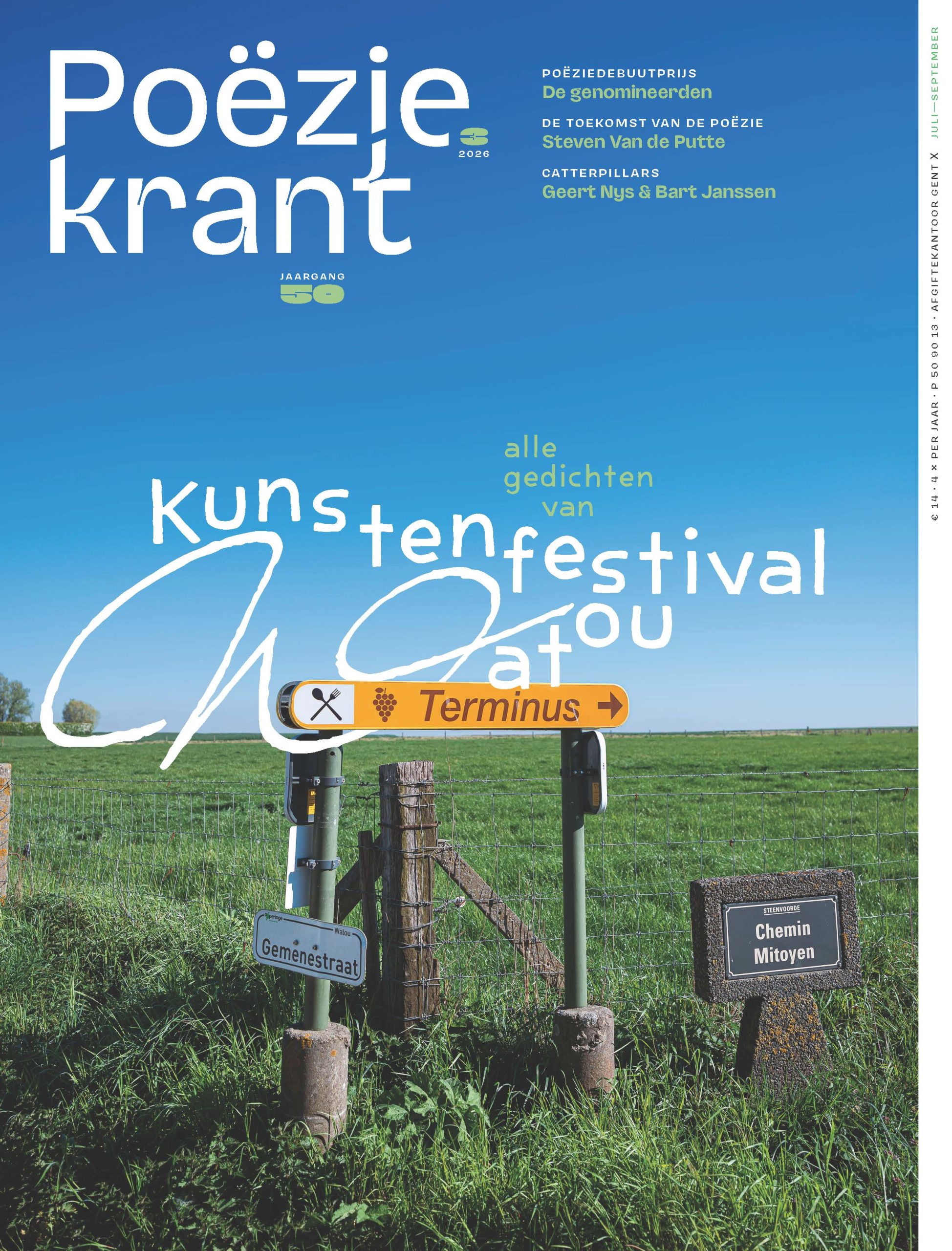
4 July 2026. In its Watou-themed issue, Poëziekrant (Ghent) publishes the interview Creative with Cheese by Anneleen de Coux. She speaks with Blobotone (Judith van der Elst & Frouke Wiarda) and Rozalie Hirs about their collaboration for the exhibition Sonic Cheese and the taste of the future: Capturing the atmospheric terroir.
Commissioned by Watou, Rozalie Hirs wrote the poetry cycle wezens van de kaas especially for the exhibition by the artist duo Blobotone. The new cycle is also published in the Watou section of the summer 2026 issue of Poëziekrant. The installation Sonic Cheese and the taste of the future: Capturing the atmospheric terroir can be visited from 14 July to 31 August 2026 as part of Watou in Poperinge, Belgium.
In the interview, Rozalie Hirs discusses the collaboration and her contribution:
“I immersed myself in the worlds of Judith and Frouke: in the sounds of the wind, the landscape, the waves, the climate, and the making of cheese. At first, I thought I would create a cycle about all these aspects, but in the end I chose to focus on the origin of the cheese itself, from the perspective of the microorganisms: the ‘we’ of the cheese. I was searching for what makes it distinctive. In cheesemaking, you are constantly witnessing transformations. The grass — which immediately influences the flavour of the cheese — is eaten by the cow. It is then digested in the cow’s stomach through different stages. Almost miraculously, milk is created. The cheesemaker then works with that milk, using their hands. Microorganisms enter the process. The cheese continues to mature, influenced by sounds and other conditions in and around the cheesemaking facility. Eventually, the cheese is eaten by people. It is tasted, digested, and excreted. In this way, it returns to the soil, after which the grass grows again. It is all both utterly concrete and mysterious, partly because these facts are accompanied by emotional elements that we cannot fully grasp, with countless associations.”
“I have always been interested in collaborations: you remain yourself while at the same time becoming part of a relationship. In doing so, you inevitably give up a small part of yourself. That is simply part of it. Perhaps women are more accustomed to giving something of themselves in service of a larger whole? In any case, a collaboration is always enriching. Ultimately, you want to write something that you would never have written otherwise. And to grow. To transform. I think that, in a way, all my work is about transformation. About becoming and change. And about adding something new: a new experience.”
“In my first poetry collections, Locus (1998) and Logos (2002), I was already working with thought dashes. Later, I gradually abandoned them, along with all other punctuation marks. This culminated in my seventh collection, oneindige zin (2021), which can almost be read as one endlessly long sentence. In 2023, ecologica followed — about the multiple languages of nature. In dagtekening van liefdesvormen (2024), I tried to make things ‘simpler’ again, with shorter sentences. And what is interesting now? In my new collection vragen naar het begin, I once again use thought dashes — just as I do in the cycle I wrote for Watou. I will never let go of that infinite sentence. It has become something of a signature: the sentence that propels itself forward and keeps going, like life itself. That sentence is a metaphor. My thought dashes are small pauses, moments of reflection that allow the reader to rest. They are links between the parts of the sentence, allowing me to build this infinite sentence. At the same time, they refer back to my earliest ideas about poetry.”
“It is indeed about the cyclical: the seasons, ripening… But at the same time, that ‘we’ of the microbiome continues to exist far longer than the people who are here now. It is also about the infinity of that ‘we’, which continues to exist in many different forms. That can be frightening, because it confronts us with our own mortality. The cow dies too, and the cheese is eaten. But the microorganisms survive us all and will eventually give rise to entirely different things. I can continue to marvel at that. There is a great beauty in it.”
The full interview appears in the new issue of Poëziekrant and is also available online. The accompanying poetry cycle of eleven poems can be read here. Enjoy reading!