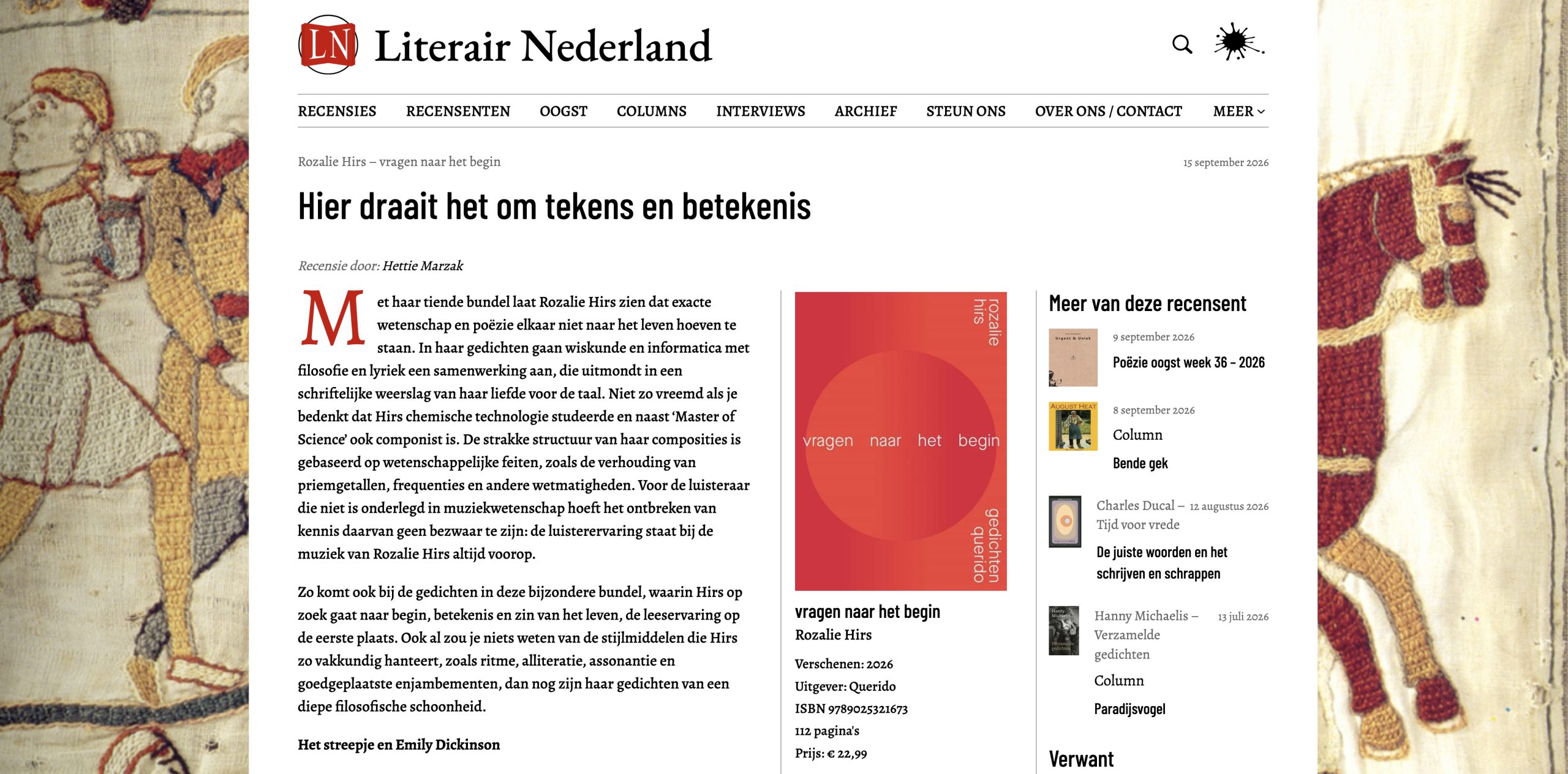
15 September 2026. Today, Literair Nederland published Hettie Marzak’s wonderful review, ‘It’s all about signs and meaning’, of Rozalie Hirs’s recent collection vragen naar het begin. Marzak writes, among other things:
“These abstract poems occupy a singular place in contemporary poetry. They might be called meta-poems, since they describe the making of other poems while also referring to themselves. But whatever name we give them, it is rare to encounter poems as intriguing and thought-provoking as those of Rozalie Hirs.”
“In Hirs’s poems, the dash brings Emily Dickinson to mind. Dickinson’s poems are full of this punctuation mark, which creates spaces of hesitation and openness in the language: words are separated from one another while remaining charged with meaning. Hirs does something similar. She draws words and concepts apart, and precisely because she leaves this space between them, the reader pauses to consider what might be meant. Her sentences are never quite finished. Instead, they continually invite new connections, forming a long, unfolding train of thought that is constantly renewing itself. Yet her poems never become labyrinthine. Hirs is too lucid and sincere for that.”
“The same is true of the poems in this remarkable collection, in which Hirs explores the origins, meaning, and purpose of life. Here, too, the experience of reading comes first. Even without knowing the poetic techniques she uses so skilfully, such as rhythm, alliteration, assonance, and carefully placed enjambments, her poems possess a profound philosophical beauty.”
Read Hettie Marzak’s full review in Dutch in Literair Nederland (15 September 2026).
An English translation of the review appears below.
Hettie Marzak: it’s all about signs and meaning
With her tenth collection, Rozalie Hirs shows that science and poetry need not be at odds. In her poems, mathematics and computer science meet philosophy and lyricism, resulting in a written expression of her love of language. This is perhaps not surprising, given that Hirs studied chemical engineering and is both a Master of Science and a composer. The precise structures of her compositions are based on scientific principles, such as the relationships between prime numbers, frequencies, and other patterns. For listeners without a background in music theory, however, this need not be a problem: with Hirs’s music, the experience of listening always comes first.
The same is true of the poems in this remarkable collection, in which Hirs explores the origins, meaning, and purpose of life. Here, too, the experience of reading comes first. Even without knowing the poetic techniques she uses so skilfully, such as rhythm, alliteration, assonance, and carefully placed enjambments, her poems possess a profound philosophical beauty.
The dash and Emily Dickinson
Throughout the collection, Hirs uses almost no punctuation beyond the occasional question mark, an exclamation mark, and the frequent em dash. The em dash has recently acquired a bad reputation because it is sometimes seen as a sign of AI-generated writing. But this is, of course, nonsense: the dash has been used for a very long time to interrupt a sentence, introduce a turn or clarification, or open a space for multiple interpretations.
In Hirs’s poems, the dash brings Emily Dickinson to mind. Dickinson’s poems are full of this punctuation mark, which creates spaces of hesitation and openness in the language: words are separated from one another while remaining charged with meaning. Hirs does something similar. She draws words and concepts apart, and precisely because she leaves this space between them, the reader pauses to consider what might be meant. Her sentences are never quite finished. Instead, they continually invite new connections, forming a long, unfolding train of thought that is constantly renewing itself. Yet her poems never become labyrinthine. Hirs is too lucid and sincere for that.
The many meanings of zinspelingen
In one of her poems, Hirs writes that everything revolves around signs and meaning, including art and beauty, but also language, love, and life itself. It is fitting, then, that the collection opens with a section titled zinspelingen, a word that resonates with several distinct meanings and associations: allusion, wordplay, suggestion, implication.
“alles draait om betekenis –
tekens staan voor iets anders vreemd genoeg –
heb je al een manier om ze te kennen
te begrijpen wat er staat?
dan maakt inspanning je verbeelding –
wakker – voltooi je het proces
door naar de oorspronkelijke boodschap te gaan
en het kunstwerk zelf af te maken –
dan voel je schoonheid – niet als een eigenschap
waargenomen – maar als iets wat je gewoon volgt
in de hoop de indruk onuitwisbaar te maken
op voelen denken –
in de hersenen dus is het
waar je affiniteit of angst ontwikkelt –
je wordt geboren – uit schoonheid
die je kiest – of zoiets”
Hirs always places the title of a poem at the bottom of the page, as if it were an afterthought, or perhaps a reflection, meditation, or conclusion to what has preceded it.
Reflections of states of mind
The second section, the origin is a forgotten movement, is more overtly scientific. Its poems explore the universe, chemical elements, and geographical locations. “– everything comes to us – / through the lens of imagination // and limitation”, Hirs writes in her poem ‘yes’, suggesting that natural phenomena, too, can reflect our states of mind.
More than half the collection is devoted to its third and final section, Wittgenstein’s Ladder, subtitled meditations. In his Tractatus Logico-Philosophicus, the Austrian philosopher Ludwig Wittgenstein (1889–1951) explored the limits of language and their relationship to reality. He later described his propositions as a ladder to be climbed: once one has reached the top and gained a comprehensive view, the ladder can be discarded, having served its purpose.
Hirs uses this ladder as the inspiration for 55 ‘meditations’ that explore a deceptively simple question: what is a poem, and what is not a poem? These are reflections on words and images, on the mechanisms by which a poem comes into being. At times Hirs considers the process with almost clinical precision; at the same time, emotions such as love and wonder keep finding their way into the poems.
Language creates the world
She begins with the stars: visible to us, yet ultimately beyond our comprehension, and invested with meaning according to the way we perceive the world. The same is true of language. We can speak about it, but only through shared understanding can we interpret signs and meanings. In this sense, language creates the world we inhabit. Hirs explores this idea in ‘frayed edges of the poem’:
“een gedicht onthult zichzelf nooit volledig –
zoals een uitdrukking zichzelf niet volledig verklaart –
het verwijst naar iets wat buiten ligt – zijn structuur begrenst
wat het kan zijn – juist die grens maakt betekenis mogelijk –
het wezen van een gedicht is wat het deelt met alle gedichten
die betekenis scheppen – zijn vorm ontstaat door keuzes –
elke keuze sluit andere uit en legt zo structuren bloot –
geen gedicht kan zichzelf volledig omschrijven –
geen functie kan zichzelf bevatten – het gedicht draagt
zijn eigen vorm – niet zijn volledige uitleg –
een gedicht onthult wat erin besloten ligt –
niet zichzelf”
Unlike Wittgenstein, Rozalie Hirs does not ask us to reach the top of the ladder, pull it up behind us, and throw it away. With her, we can look both up and down, at what lies before and behind the wall: the history of how a poem came into being and the result.
“de ladder is er om te beklimmen – niet om te bewaren –
zie – en laat los – de sterren stralen door
zonder te vragen waarom”
These abstract poems occupy a singular place in contemporary poetry. They might be called meta-poems, since they describe the making of other poems while also referring to themselves. But whatever name we give them, it is rare to encounter poems as intriguing and thought-provoking as those of Rozalie Hirs.
(Hettie Marzak, Literair Nederland, 15 September 2026)