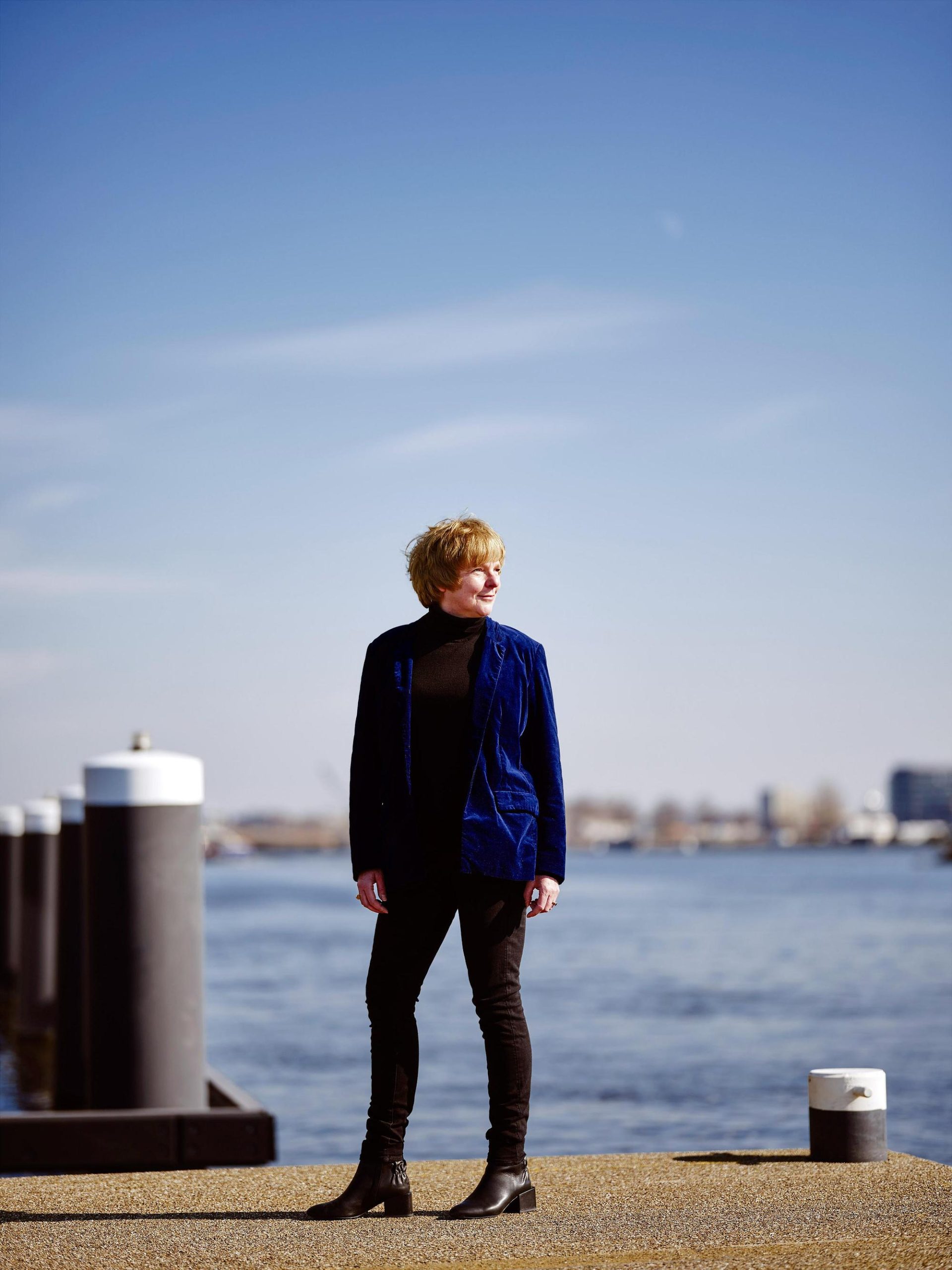
9 April 2026. Today saw the publication of Bas van Putten’s review “Listening-Reading” in De Groene (print & online) of the recent album Rosehart (2026) by Rozalie Hirs. The photo (online) is by Roger Cremers. Van Putten writes, among other things:
“You hear showers of stars, magic scenes in fairytale forests. Episode E is an Arcadian valley with dense rustling and shimmering rivulets of glockenspiel, piano and celesta and cymbals, electronics and softly tremolando strings.
Rozalie Hirs (1965) is a composer and poet—in both capacities everything that ignores time. That ought to change. Roseherte (2008) for orchestra and electronics is a magnificent work. Hirs calls it, almost in the tradition of Liszt, a symphonic poem. It lasts a quarter of an hour and there is a story. Roseherte—the title a self-fashioned Middle Dutch—is a mythical creature containing Hirs’s concealed name: Rose for Rozalie and hert, the Dutch for the German Hirsch. The creature is awakened and sets out on a journey, ‘in rain and sunlight, beneath rainbows and zeppelins, singing of clouds and time, accompanied by the hum of high-voltage cables.’ Excellent. The sounding becomes image, ‘sound the narrative.’ Thus, riding on the back of Roseherte—if the fabulous beast does not throw the listener—anyone can partake in listening-reading at will.
One might hear pillar art in Roseherte: columns of sound, the delicate fabric woven around pairs of dominant seventh chords whose roots lie a fifth apart. In this way complex harmonic tensions arise that sift the total sound. From that comes a strange, spatial hovering—acoustic northern lights. The degree of shimmer in the wandering mass of sound varies from ‘pure radiant tone’ via ‘slight vibrato’ to ‘vibrato estremo,’ and back again to a ‘non vibrato, very pure.’ Everything moves microtonally, microcosmically, in stepwise fashion from far to farther and then very near again, the wind tones of the winds dissipating seamlessly from concrete pitch into a breath sound not bound to pitch.
So music travels, so does Roseherte. Gradually the piece becomes a dream landscape, the setting of the journey. The pillars become mountains where the composer sits striking out sound with hammers, hard and soft, as though in the distance the foundations are being driven for a great mythical creature of which the music might be the shadow. But the sound itself is the edifice, a form in the making with a wandering protagonist—a genesis unbound by a script. Hirs remains a poet. You hear showers of stars, magic scenes in fairytale forests. Episode E (‘amoroso, espressivo’) is an Arcadian valley with dense rustling and shimmering rivulets of glockenspiel, piano and celesta and cymbals, electronics and softly tremolando strings. A diadem of the fabulous creature, or a thought, or the animal’s first infatuation with whomever or whatever—no human will know. So unbound, music can justifiably be anywhere, even in the other.
At rehearsal mark H—and not only here—Roseherte becomes halting Messiaen. Enchanting: in the midst of a dream episode at rehearsal mark L, the harps swell like a sweet storm—pure Debussy—so direct in its ardor it aches. The ending, with maximally divided strings in triple piano, is enchanting. Fellow poet Micha Hamel conducts the Netherlands Radio Philharmonic Orchestra excellently. Fascinating. I know little Dutch music that is so exclusively about harmony. There is more on this CD: Arbre généalogique, a tone poem, and the gleaming, sonorous Avatar and Bron, for the ear parts two and three of the journey. Invent your own story to go with them. It’s worth it.”
©2026 Bas van Putten
Published in De Groene Amsterdammer under the title “Classical | Rozalie Hirs: Listening-Reading.” Bas van Putten (photo: Roger Cremers). Arts & Culture: Classical. De Groene Amsterdammer (magazine), April 8. Read the full review online at De Groene.